Picture a European manufacturing company that has just rolled out an internal AI assistant. The IT team has done its homework.
Employees authenticate through company-managed identities. Model access is restricted to approved providers. API keys are centrally managed. Usage limits, routing and observability are handled by an AI gateway. Everything looks good.
Then a procurement employee asks the assistant to summarize a supplier agreement containing confidential pricing, negotiated discounts and contractual conditions.
The employee is authorized. The model is approved. The gateway accepts the request. But the company never intended that information to be shared with an external AI provider.
Nothing necessarily went wrong with authentication or model routing. The missing control was about what the organization permits people to do with AI - not merely which AI services they're permitted to access. And that's a different kind of policy decision.
The gateway is doing an important job
AI gateways are becoming a natural component of enterprise AI infrastructure. They centralize model access, manage credentials, route traffic between providers, enforce quotas and provide operational visibility. These are essential capabilities.
Modern AI gateways can also perform content inspection. Solutions such as LiteLLM and Kong support guardrail integrations, prompt filtering and other security controls. So the distinction isn't that gateways handle access while guardrails handle security. The boundary isn't that simple.
The more important distinction is between infrastructure-level controls and business-specific policy decisions.
A gateway can establish that a request comes from an authorized application, targets an approved model and remains within its usage limits. But whether that particular request is acceptable may depend on information that goes far beyond those checks.
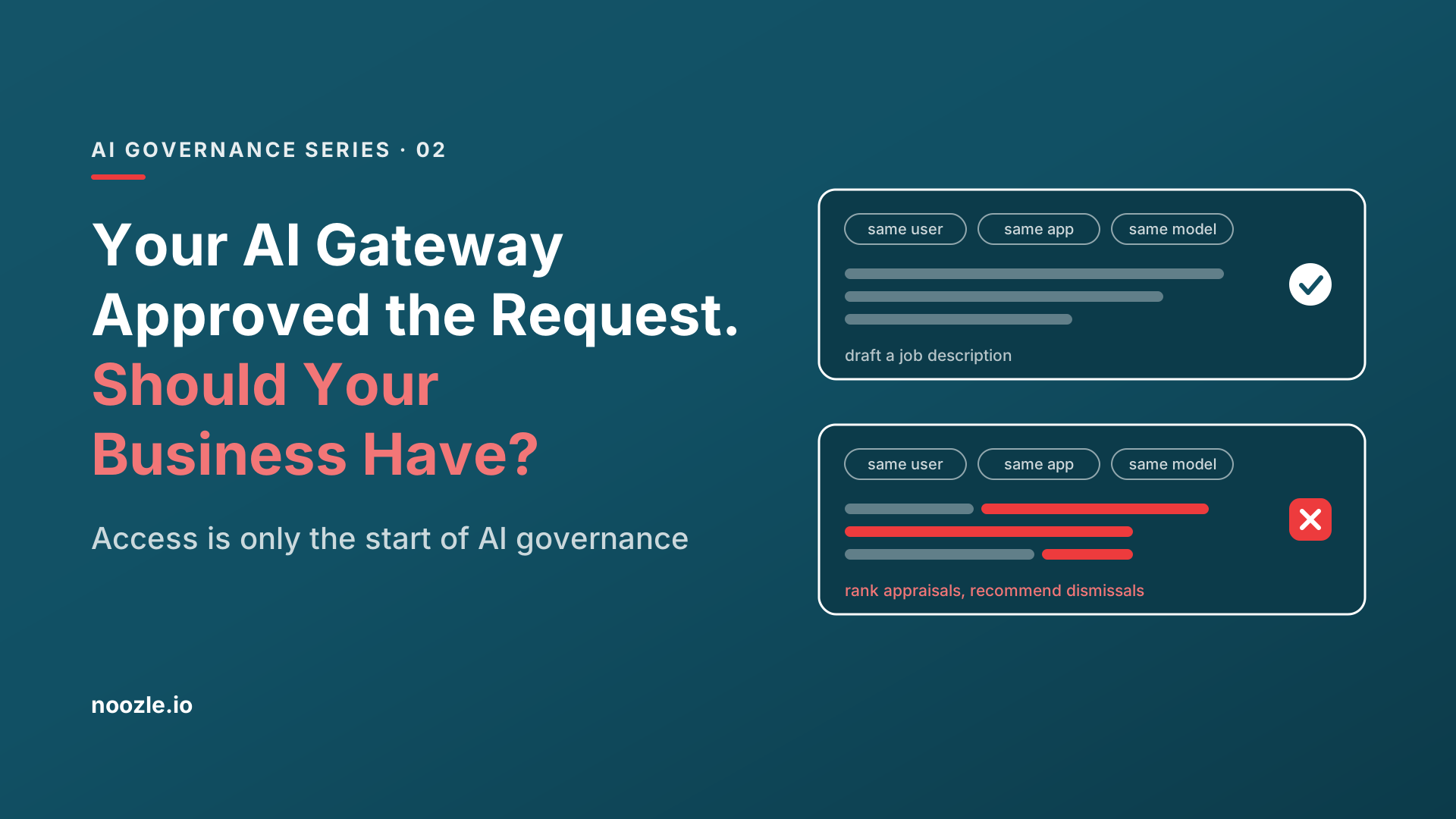
Consider two requests from the same procurement employee:
- "Summarize this publicly available product specification."
- "Summarize our confidential agreement with Supplier X, including negotiated unit prices and volume discounts."
Same application. Same identity. Same model. Different business implications. To distinguish them reliably, the enforcement layer needs to understand the request and the relevant business context.
Enterprise policies are rarely simple yes-or-no categories
Many AI security controls are organized around recognizable risks: personal information, credentials, toxic content, prompt injection or prohibited topics. These are useful starting points. But enterprise policies are often much more specific.
- A manufacturer might prohibit confidential supplier pricing from being sent to external models while allowing the same information to be processed in an approved private environment.
- A financial services company might restrict which teams can use AI to prepare certain customer-facing communications.
- A sales organization might allow an assistant to discuss standard discounts while prohibiting unauthorized commercial commitments.
None of these rules can be adequately described by a single generic category. They depend on combinations of conditions:
- Content: What information is being processed? Does it contain confidential terms, protected records or other business-sensitive material?
- Context: Which user, department, application or agent submitted the request?
- Destination: Which model or environment will receive the information?
- Exceptions: Under what circumstances is the operation permitted?
A well-designed policy enforcement system must evaluate these conditions together. And it should use trustworthy information wherever possible.
For example, a document's authoritative confidentiality classification is stronger evidence than simply finding the word "confidential" in its text. Semantic analysis can help identify sensitive concepts expressed in different ways, but it should complement - not replace - reliable metadata and explicit business rules.
The goal isn't to make AI guess what company policy means. It's to make company policy executable.
If you can't read the policy, can you really govern it?
There is another problem that often becomes visible only after an organization deploys its first generation of guardrails. Who actually understands the rules?
Imagine that a legitimate customer-service request has been blocked. The security dashboard reports:
"Blocked: sensitive information detected."
That may be sufficient to identify the general category of the problem. But it doesn't necessarily answer the questions that follow.
- Which condition matched?
- Did a semantic score exceed its configured threshold?
- Did the rule consider the user's team or the selected model?
- Was an exception evaluated?
- Which version of the policy produced the decision?
These details matter when security teams investigate false positives, approve exceptions or demonstrate that controls behave as intended.
A readable policy also changes how teams collaborate. Security can specify what must be protected. Legal and compliance can review the relevant restrictions. Business owners can validate exceptions. Engineering can test and deploy the resulting behavior. And when the policy changes, everyone can review what changed.
A policy that can be inspected, versioned and tested is easier to govern than one that exists only as an opaque detector configuration.
Explainability doesn't mean every interaction needs to retain its entire prompt and detailed reasoning indefinitely. Routine decision records and authorized diagnostic traces can serve different purposes. The important point is that security teams need access to meaningful evidence, not merely a count of blocked requests.
Agentic AI makes the distinction even more important
Traditional AI assistants mostly generate answers. AI agents can also initiate actions. They can issue refunds, update records, interact with procurement systems, send communications or invoke application APIs.
An agent might be authorized to access a refund tool without being authorized to issue refunds of arbitrary amounts. This introduces another distinction: Permission to use a tool is not permission to perform every possible action with it.
The enforcement decision may need to consider the tool being called, its arguments, the agent's identity and the business rules governing the operation. For example, a customer-service agent could be permitted to issue refunds up to €200 autonomously, while larger refunds require an explicitly authorized approval.
A system prompt telling the agent to respect that limit isn't sufficient. The operation must be checked before execution. Nor should an external guardrail become the only authorization control. The application executing the refund must independently enforce its own permissions and transaction limits.
This is defense in depth: policy evaluation helps prevent inappropriate actions, while the underlying business system remains responsible for final authorization.
OWASP's guidance on agent security reinforces the importance of least privilege, tool restrictions and independent validation of consequential actions.
Enforcement must remain practical at scale
There is a final consideration that receives less attention than it deserves: performance. A company might begin with a few dozen AI policies. As AI adoption expands across departments, applications and agents, the catalogue can grow to hundreds or thousands.
Security requirements become more detailed. Business teams request exceptions. New regulations and internal procedures introduce additional conditions.
If every increase in policy coverage makes AI applications noticeably slower, governance becomes harder to maintain. Latency is especially important for agentic workflows, where a single user request may involve many consecutive AI interactions and tool calls.
This is why organizations should evaluate not just average guardrail latency, but also tail latency. A low p50 indicates that typical evaluations are fast. A predictable p99 matters because unusually slow evaluations can affect user experience, service-level objectives and multi-step operations.
There is no universal guarantee that adding policies has zero performance cost. Complexity, request content and workload characteristics all matter. But the ability to grow policy coverage without proportionally increasing enforcement latency should be an explicit architectural requirement. Ask vendors to demonstrate this behavior under realistic workloads, rather than relying solely on headline latency figures.
Five questions worth asking before your next AI rollout
For CISOs, CTOs and AI platform owners, a useful assessment starts with five questions:
-
Can we enforce our own business rules? Not just predefined security categories, but conditions specific to our organization.
-
Can policies combine content and context? Including trusted data classifications, identity, application, model destination and business-specific exceptions.
-
Can we explain and test decisions? Including which policy revision applied, what matched and how changes affect known cases.
-
Can we enforce rules at the right point? Before sensitive information reaches a model, before an inappropriate response is delivered, or before an agent action is executed.
-
Can the system scale operationally? With manageable policy changes, predictable latency and evidence suitable for security investigations.
These questions are relevant whether policy enforcement is built into an AI gateway or provided by a dedicated service integrated with it. What matters is the capability and its reliability - not the number of products in the architecture.
From AI access to AI control
At Noozle Labs, this distinction shapes how we're building Noozle Gate. Rather than replacing an organization's existing AI gateway, Gate works alongside it to evaluate readable, customer-defined security and business policies.
These policies can combine structured conditions and semantic matching, apply to AI requests, responses and supported agent interactions, and produce decisions associated with specific policy revisions.
The objective is straightforward: help organizations enforce the rules that matter to their business while keeping those rules understandable, maintainable and practical for production systems.
Because an AI gateway can correctly authorize a request. But an authorized request isn't necessarily an acceptable use of AI. And enterprise AI governance begins with understanding the difference.
Noozle Labs - Practical AI security, governance and policy enforcement.