In Short
- An AI gateway gives the AI traffic you route through it one control point: identity, access, routing and a record.
- What it allows depends on the policy checks connected to it, including your own business rules.
AI adoption has outrun most organisations' ability to govern it. Product teams call several model providers, employees use chat assistants and coding copilots, and agents hold tokens to the CRM and the data warehouse. Each path carries sensitive data, often to providers outside the EU.
Netskope's 2026 threat report for Europe finds that 99% of the organisations it monitors use AI apps, and that regulated data, chiefly personal data, accounts for 59% of data-policy violations in AI and personal cloud apps. The question is no longer whether prompts leave your perimeter. It is whether anything checks them, and whether you can prove it.
What an AI gateway is
An AI gateway is a control point that people, applications and agents go through to reach models, tools and other agents. Unlike a traditional API gateway, it understands what is inside an AI call: which model is called, which tools are offered, which tool the model wants to run and with what arguments. That is what makes rules such as "a customer's IBAN never reaches a model hosted outside the EU" or "a support agent is never offered a payment tool" enforceable. A gateway that speaks the Model Context Protocol (MCP), used by agents to reach tools, and Agent-to-Agent (A2A) can govern agent traffic too.
How it works
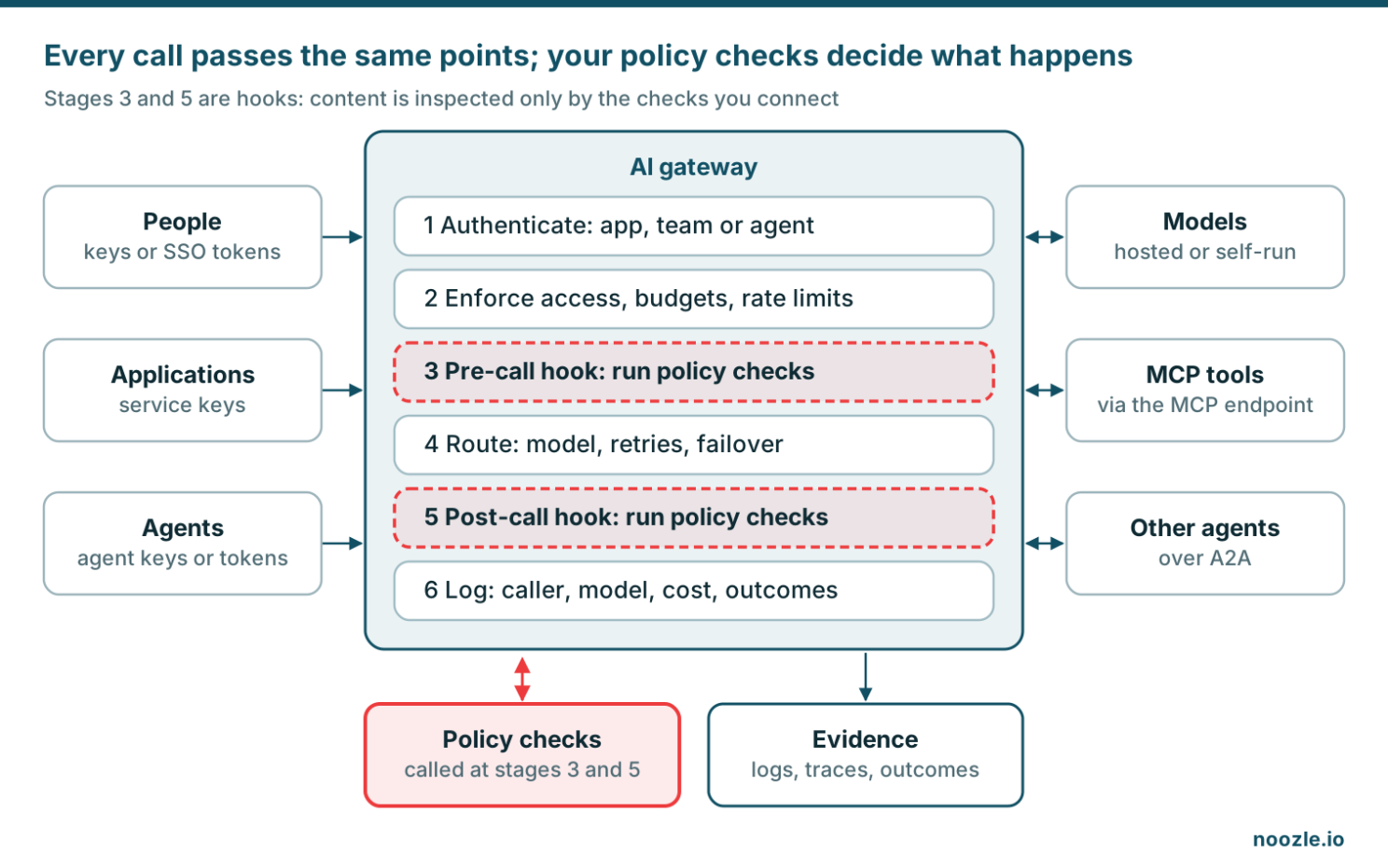
A typical gateway processes each call in six stages:
- Authenticate the application, team, person or agent.
- Enforce access and limits: which models and tools, within what budget.
- Pre-call hook: policy checks inspect the request before it leaves.
- Route to the configured model, with retries and failover.
- Post-call hook: policy checks inspect the response. Holding a streamed answer until it is checked prevents leaks but adds latency; checking it as it flows is faster but less preventive.
- Log the call and the outcome of every check.
This separates two jobs. The gateway provides the control point. The policy engine connected at the hooks decides what is allowed, and the expressiveness of its policies determines what you can actually control.
Security: prompts became actions
Prompt injection, text crafted to make a model ignore its instructions, became dangerous the day models got tools. The OWASP Top 10 for Agentic Applications lists agent goal hijack and tool misuse as its first two risks, and dozens of MCP-related vulnerabilities were filed in early 2026.
A gateway can stop a dangerous tool call before it runs: if the post-call hook blocks the response that proposes it, the application never receives it. Tools reached through the gateway's MCP endpoint can be restricted per agent, with arguments checked before execution. Tools connected directly, or run by the model provider on its own servers, must be routed through the gateway or switched off.
Compliance: show what your AI did
Under GDPR, your organisation stays accountable for the personal data it sends to AI providers, and sending it outside the EEA needs a valid transfer mechanism. The EU–US Data Privacy Framework covers certified US providers today, but its two predecessors were struck down in 2015 and 2020, and it is now before the EU Court of Justice. Routing sensitive traffic to EU-hosted models is a sensible safeguard. The EU AI Act adds deployer duties: from December 2027, high-risk uses such as recruitment and credit scoring need human oversight and at least six months of the logs under the deployer's control. DORA requires financial entities to govern model providers as ICT third parties.
Most incidents start inside the companies that use models. The Dutch data protection authority received dozens of breach reports in 2024 and 2025 from organisations whose staff pasted personal data into chatbots. In late 2025 the municipality of Eindhoven found that, in 30 days, employees had entered CVs, youth-care files and internal reports into public chatbots. Its response is the pattern to follow: block public AI services and give staff a sanctioned route, so the gateway becomes the only way out.
A written policy states the rule; enforcement and an auditable record prove it is applied.
Your rules, not just security rules
A generic guardrail can detect a card number or a prompt injection. But who decides that a sales assistant may not offer discounts above 15%, that a support chatbot may not promise refunds outside the contract, or that an agent may not modify production data? These are company policies, and recent incidents show four kinds:
- Business claims. In May 2026 the Higher Regional Court of Hamm ordered a cosmetic surgery clinic to stop its website chatbot describing the clinic's doctors as certified specialists, titles they did not hold. The court treated the answers as the clinic's own statements.
- Communication. In January 2024 DPD disabled the AI part of its chatbot after a customer got it to swear and call DPD useless.
- Data handling. In 2023 Samsung banned generative AI tools after engineers pasted proprietary source code into ChatGPT.
- Actions. In 2025 Replit's coding agent deleted the live database of a founder's project during a declared code freeze, despite instructions not to make changes.
There the rule existed only as a prompt instruction. An instruction is a request; a rule enforced outside the model is a control.
Some of these rules are deterministic: a discount above 15% in a tool's arguments, a delete command in production, a project codename in a prompt. Others, such as a misleading claim about qualifications, need semantic evaluation and carry a measurable error rate. Both need an owner, tests, versions and a decision that can be explained.
What to look for
- compatibility with your teams' LLM APIs and identity provider, so adoption is mostly configuration;
- policy hooks on input, output and tool traffic, open to third-party engines;
- rules your business teams can read and own, with an observe-only mode;
- predictable p99 latency as policies grow, and a defined fail-open or fail-closed behaviour;
- durable evidence of every decision, without storing prompts;
- deployment in the EU or on your own premises;
- a hardened supply chain: the gateway holds every provider key, and in March 2026 attackers trojanised a widely used open-source LLM proxy.
Who writes the rules?
A gateway gives you the control point; a policy engine turns written intent into decisions that can be tested and audited. That separation is the principle behind Noozle Gate. It works alongside your AI gateway and lets teams express security and business policies in a readable rule language, enforce them on prompts, answers and agent tool calls, and trace every decision to the rule and revision that made it.
If your organisation already routes AI through a gateway, who writes the rules it enforces: security, developers, or the business owners accountable for what your AI says and does?
Your rules, on every prompt and every data stream.